
In a previous post we spoke about the success of the 2026 Race Unity Speech Awards. In this post we will share some insights about why the social media campaign was so successful.
The 2026 Race Unity Speech Awards campaign revealed a useful truth about social content: likes and shares are not the same signal.
Likes show approval. Shares show usefulness.
That distinction mattered throughout the campaign.
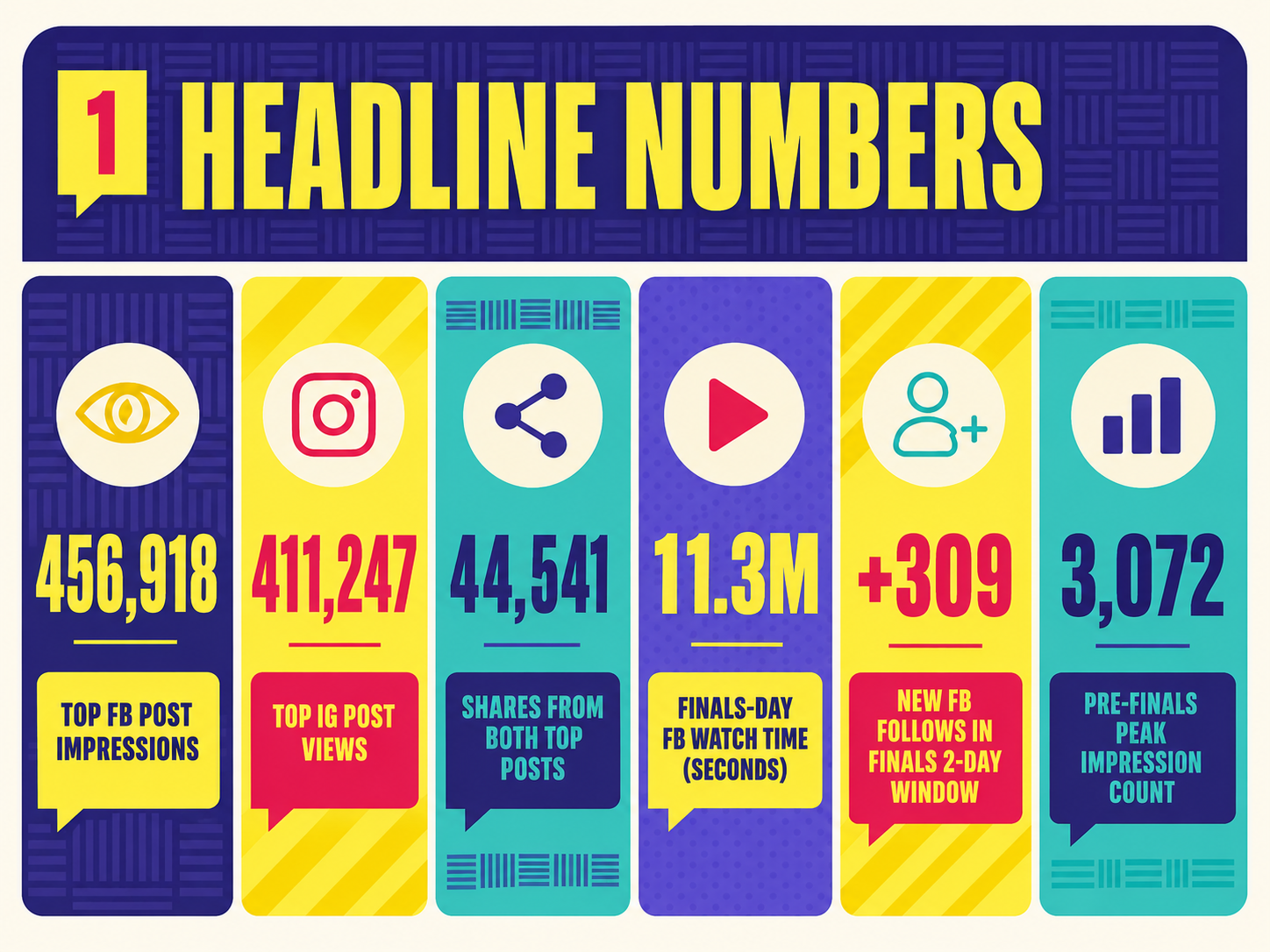
Across Finals weekend, Race Unity content moved well beyond the immediate event audience. The top Facebook post generated 456,918 impressions. The top Instagram post reached 411,247 views.
Finals-day Facebook watch time reached 11.3 million seconds. In the two-day Finals window, the Facebook page gained 309 new followers, after averaging between zero and five per day across the previous 12 weeks.
But the most interesting finding was not reach. It was how people used the content.
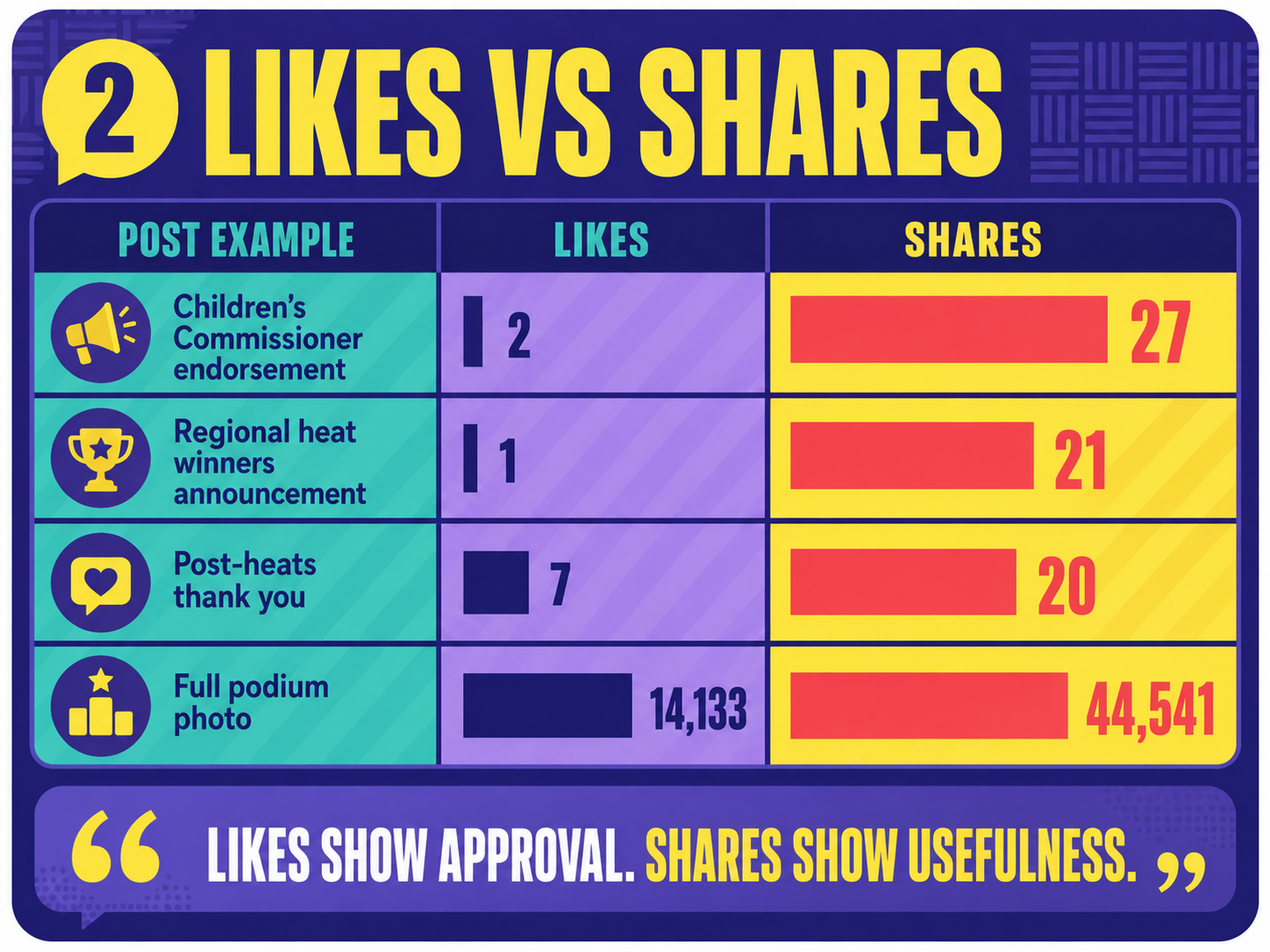
Some posts generated high share rates with very few likes. A Children’s Commissioner endorsement on Instagram had two likes and 27 shares from 95 reach. A regional heat winners announcement had one like and 21 shares. A post-heats "thank you" had seven likes and 20 shares.
The clearest example was the full podium photo. It received 14,133 likes and 44,541 shares; more than three times as many shares as likes.
We learnt that content was not simply being consumed.
It was being passed on.
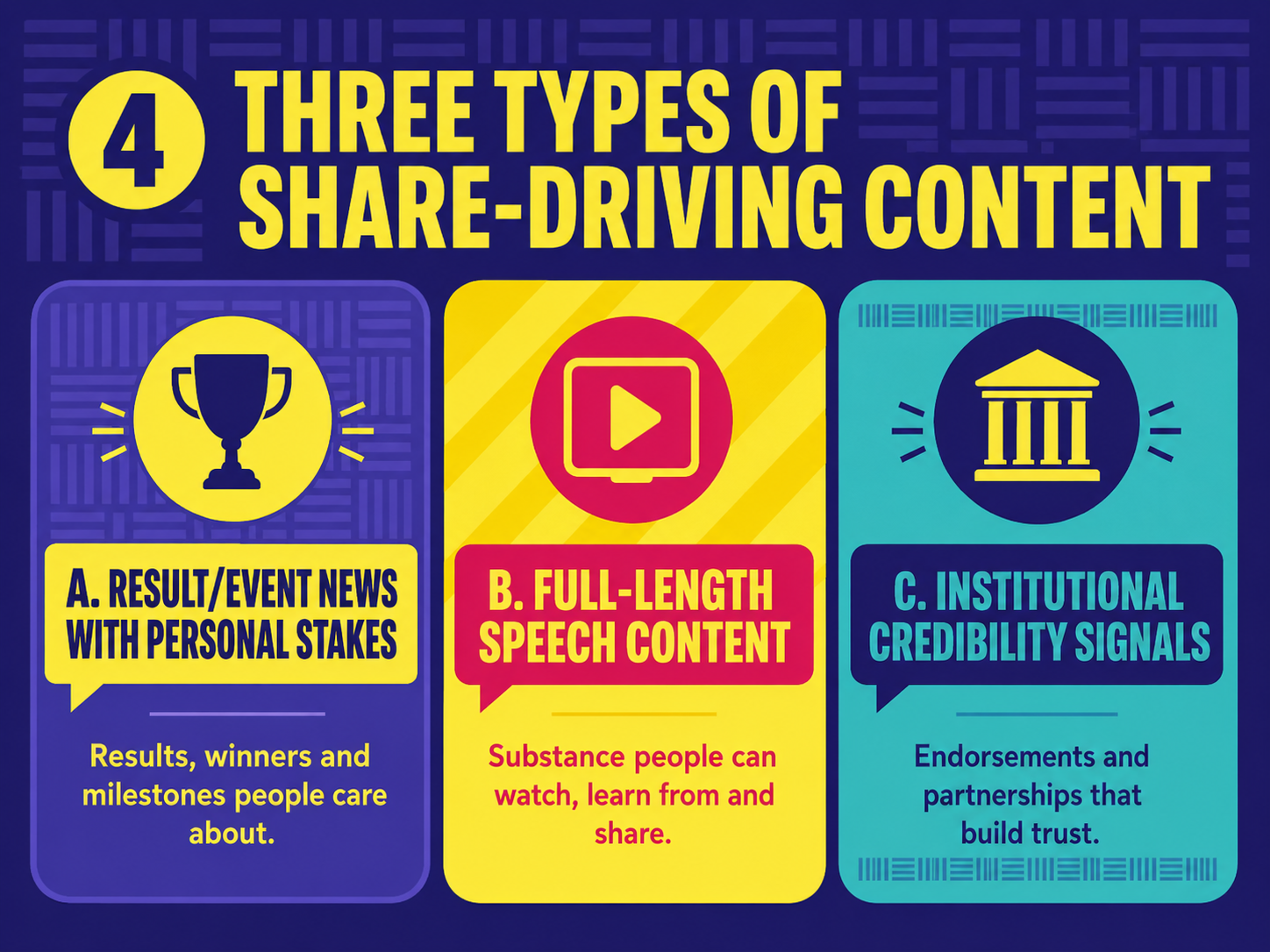
The strongest content had personal stakes.
Posts that named finalists, regions, schools and winners gave people a reason to share. Parents could recognise their children. Schools could celebrate students. Communities could support their representatives. Partners could amplify a moment aligned with their values.
The podium post featuring Lukas, Sisilia and Amanjot reached 333,532 accounts organically.
The lesson is simple: when content recognises real people, their networks do the distribution.
The full Finals replay outperformed every produced social post by a significant margin.
That might seem counterintuitive. Long-form event content is not usually treated as the most social-friendly format. But in this case, the replay became a shareable asset.
The average watch time was 4.17 seconds per view, which suggests many people did not watch it in full. But they still shared it.
That matters. The replay was not just something to watch. It was proof of the event, a record of achievement, and something worth forwarding to others.
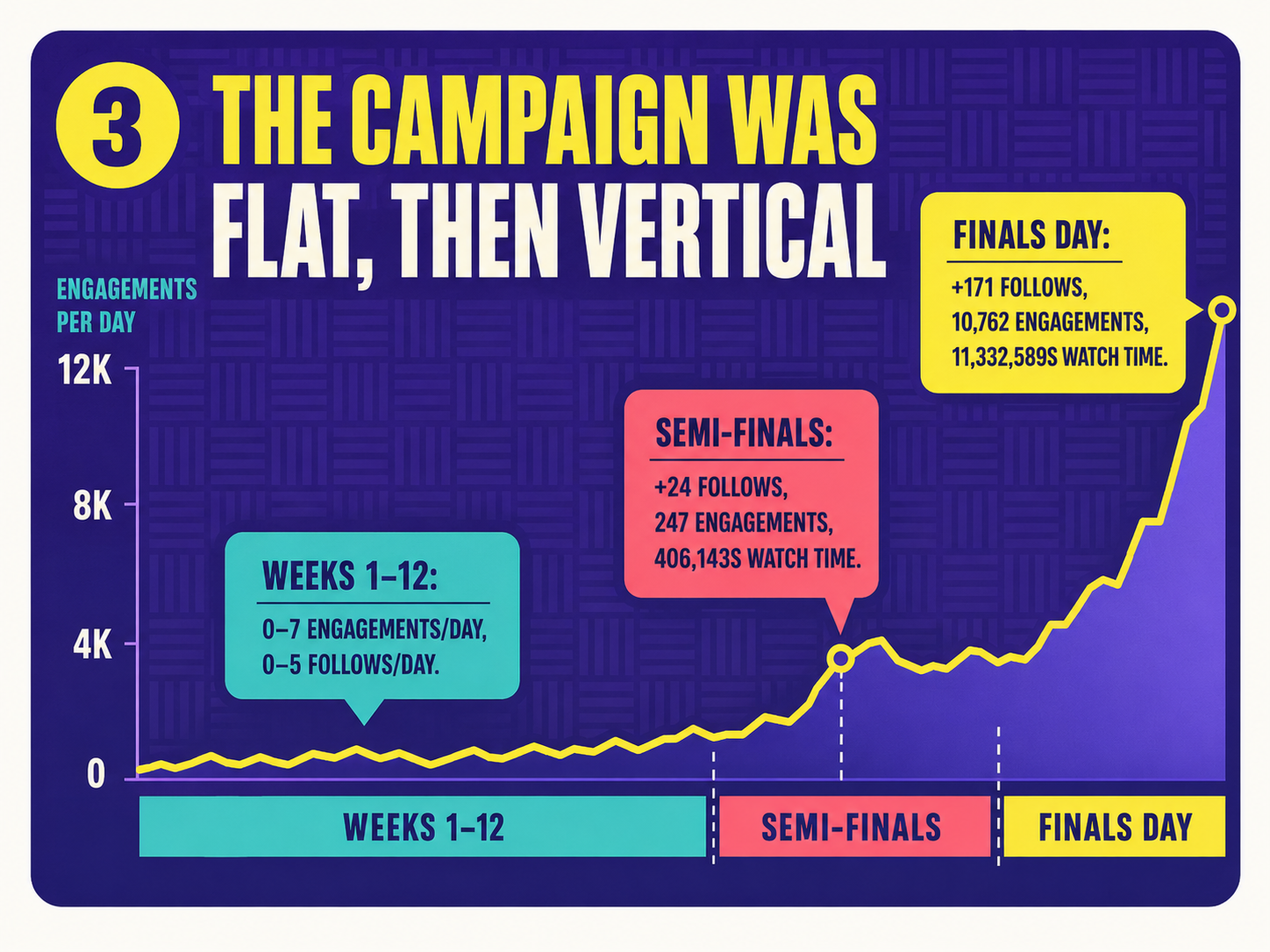
For most of the campaign, daily activity was modest. Across the first 12 weeks, Facebook engagement sat between zero and seven engagements a day, with zero to five new follows a day.
Then the Finals window changed everything.
Semi-Finals day generated 24 new followers, 247 engagements and 406,143 seconds of watch time. Finals day generated 171 new followers, 10,762 engagements and 11,332,589 seconds of watch time.
In practical terms, the campaign happened in approximately 48 hours.
The weeks before Finals still mattered. They built familiarity, context and audience readiness. But the major movement came when there was a clear moment for people to gather around.
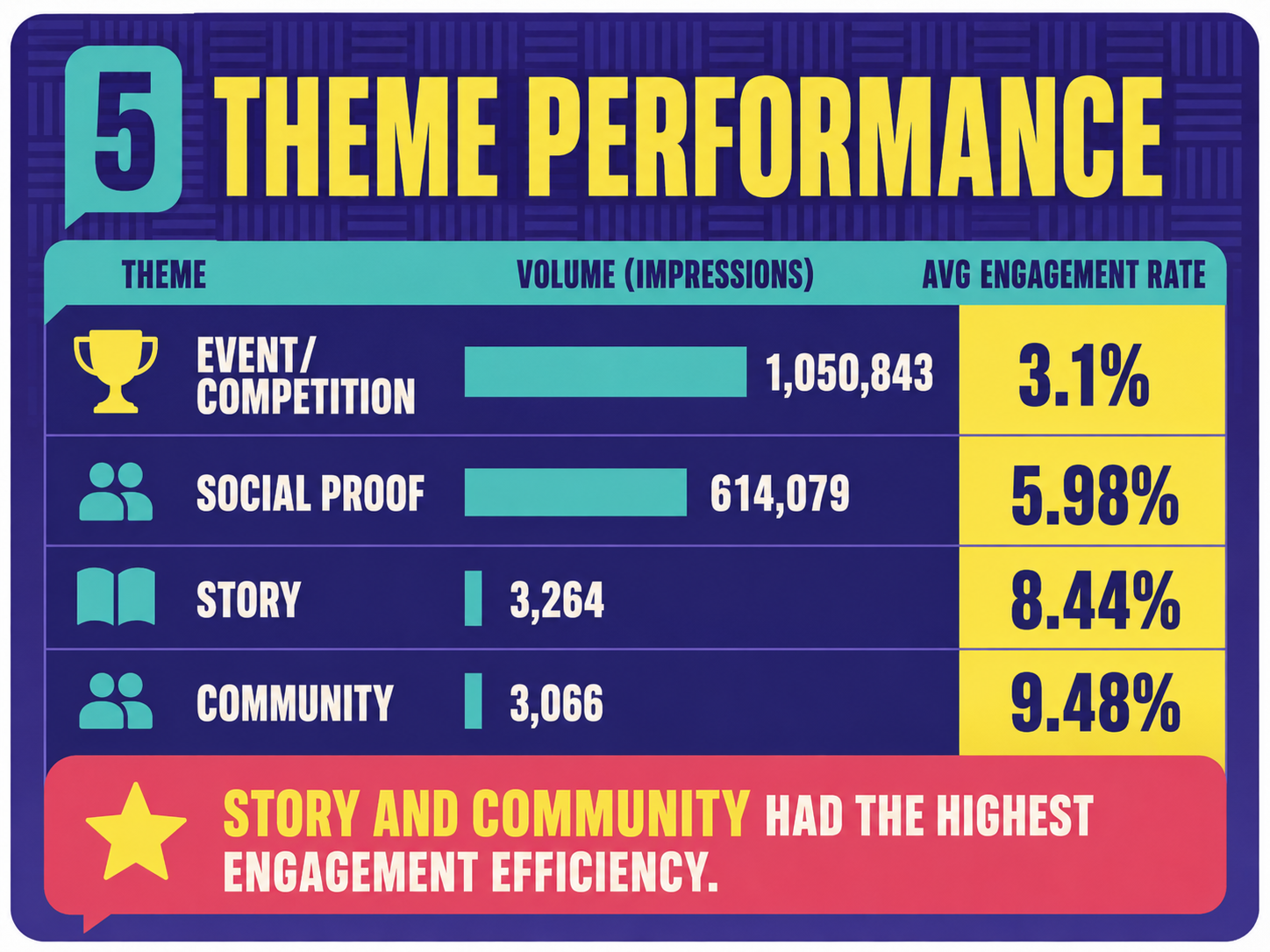
Event and competition content dominated on volume, generating more than 1 million impressions.
Social proof content also performed strongly, with 614,079 impressions and an average engagement rate of 5.98%.
But Story and Community content were more efficient. Story posts achieved an average engagement rate of 8.44%. Community posts achieved 9.48%.
That points to a useful split.
The strongest campaign used all four.
One of the strongest pre-Finals posts was the Reel built around the line: “It’s not easy to share your views on race.”
It reached 605 people, with six saves and four shares. For a small account, that was a good result.
The issue was not the quality of the content. It was the size of the audience.
For small-account campaigns, early paid support can play an important role. Not to replace organic sharing, but to give strong content enough reach to prove itself before the main campaign moment arrives.
The 2026 Race Unity Speech Awards campaign showed that the most valuable content is not always the content people visibly approve of.
It is the content they can use.
That is why shares mattered more than likes.
The campaign worked because it gave people something worth passing on.
Marque has been the brand partner of the Race Unity Speech Awards since 2019.
The Awards are presented by the New Zealand Bahá'í Community. New Zealand Police have been the Principal Partner of The Race Unity Speech Awards since 2008.
Other partners include the Human Rights Commission, Ministry of Ethnic Communities, Hedi Moani Charitable Trust, the New Zealand Federation of Te Taura Whiri i te Reo Māori, Mana Mokopuna - Children's Commissioner, NZ National Commission for UNESCO, Manukau Institute of Technology, Unitec, New Zealand Federation of Multicultural Councils and Speech New Zealand.


